6 things that make our organisation different
Autonomy, trust and freedom: six features of self-governance that make Phenisys an organisation without managers or controls, where everyone makes decisions for the good of the company.

Our organisation is unusual.
We believe that people are honest, responsible, motivated and therefore worthy of trust to make their own decisions for the good of the company. The logical consequences follow immediately: managing people becomes unnecessary, controlling them becomes absurd and keeping them within prescribed boundaries becomes counterproductive.
This belief takes shape in our organisation through three pillars: autonomy, trust and freedom.
A term has emerged to describe this: self-governance. According to some authors, it is nothing less than the next evolutionary stage beyond today's hierarchical and matrix organisations.
Introduction: unusual, but why?
In the early days of ISIS Performance in Rhône-Alpes, Sylvain, the first colleague I had the good fortune to recruit, showed an exceptional ability to work independently, which was crucial at the time. After his first year, I conducted the familiar annual performance and objectives review, shaped by my fourteen years at Orange. This exercise epitomises a style of management that asserts authority over a subordinate, tactfully referred to in French as a “collaborateur”, perhaps to suggest that the collaboration is freely chosen.
But everyone has privately recognised — meaning publicly, around the coffee machine — that it is an awful role-playing exercise, if not an outright charade.
After that review, I realised how absurd it was to treat someone so autonomous, motivated and fundamentally independent-minded in this way. There was no question of building a young company of passionate people around a “human charade”.

1. Let everyone decide the “how”
We believe that everyone only needs to understand why they work and who they work for. Once the right working conditions are in place, there is no point telling people how to do their jobs: the people we recruit are precisely those best qualified and most interested in deciding how.
As the company leader, my main responsibility is to ensure that this shared understanding of why we work and who we work for is in place, along with the right conditions for everyone to feel comfortable and decide how to work.
The magic is that there is no longer any need for a stick or a carrot to force or motivate people to work. Motivating someone is an illusion: people motivate themselves. Motivation comes both from understanding the purpose of one's actions — why and for whom — and from having control over those actions, meaning the autonomy, effectiveness and responsibility that are possible. Purpose and freedom are also a good recipe for happiness.
In practice, establishing autonomy, trust and freedom has many far-reaching consequences for the way a company is organised.
2. No managers
We do not manage people: motivated people manage themselves very well. And that is just as well, because a manager is expensive and can create unproductive activities within a company, such as reporting and the concentration or withholding of information and decisions — not to mention power games, attempts to win favour and internal politics that create no value outside the organisation.
We have leaders for the company's operational roles. These leaders act as points of contact that facilitate internal and external interactions, and volunteer to make decisions in certain areas to simplify the organisation.

3. Share decision-making authority
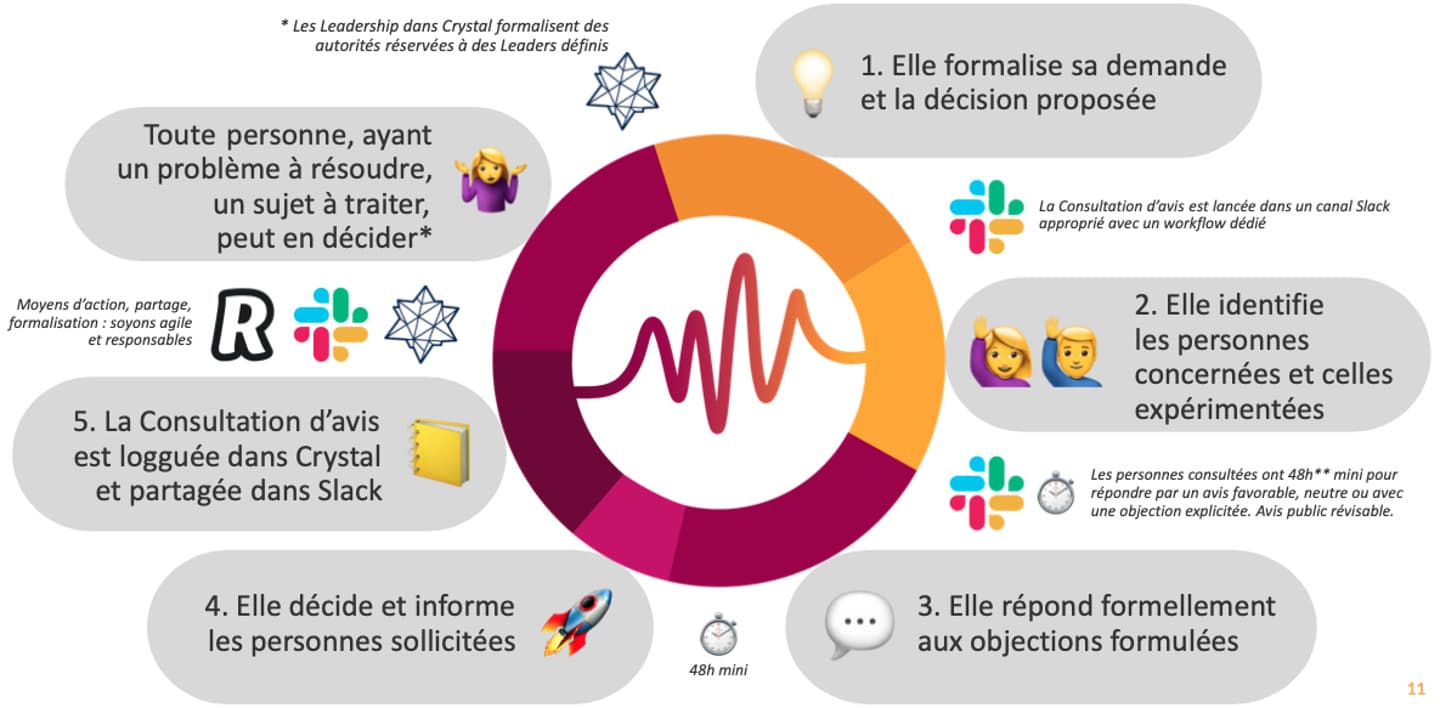
Decision-making is traditionally concentrated in the hands of managers. Without managers, that authority needs to be shared. Here, anyone can make any decision for the company — but not in just any way.
Since democracy and consensus are probably not very effective at delivering the agility our company needs, we have adopted the decision-making process that seems to be becoming the norm in self-governing organisations: the advice process.
Anyone is entitled to make any decision, but must seek advice from those affected by it and from people with expertise in the subject:
- the people affected are typically those who will “have to live with the decision”;
- the experts are anyone with expertise or relevant insight into the subject that needs to be understood before the decision is made.
Failing to consult is a breach of our company's rules. The decision-maker remains the owner of the decision and solely responsible for it, so responsibility is never diluted. That responsibility alone reduces the risk of an absurd decision or one that goes against the advice received. Only genuinely useful decisions are made, and the risk of error is spread across the company among people competent in each area, rather than concentrated in a few supposedly all-knowing minds.
4. Complete transparency, with clarity to match
Good decisions require the right information, especially financial information. Information is therefore completely transparent within the company.
In practical terms, everyone knows the company's cash position, and both expenses and income are accessible to all. As a result, everyone's salary is known to everyone else, including the company leader's.
Understanding information, particularly financial information, is also essential. We therefore make a particular effort to communicate and explain our strategy, decisions and accounts. All governance, strategy and financial management meetings are open to anyone who wishes to attend or contribute.
5. Have the ability to act
Making good decisions is not enough: to avoid a wasted effort, you also need to be able to act. Within our organisation, that ability takes two concrete forms:
- The resources: everyone has their own bank card, which debits the company's account directly. As a side benefit, this also resolves the issue of expense claims, which no longer need to be approved and then reimbursed.
- The time: everyone has the time they need for activities outside client assignments. Estimated at 20%, this is not formalised, but assignment workloads are organised so that schedules are not overloaded.
One notable benefit of shared decision-making, transparent information and the ability to act is that everyone effectively becomes an “entrepreneur” within the organisation.
6. No control
These arrangements depend on the organisation placing complete trust in its people. Once again, the implications are significant and unusual.
Contrary to the familiar management mantra that “trust does not rule out control” — a quotation attributed to Lenin that defies all logic — we do not put controls in place over people and their actions.
This is not merely a logical or moral stance: it is also a pragmatic and financial choice. What Gordon Forward called “managing for the 3%” captures the idea that 3% of exceptions end up imposing constraints on the other 97%, whose behaviour is perfectly normal, at a cost far greater than that of the exception.
I would add that this is a great relief for my own mental load as an entrepreneur. As for the company, it is easy to see how that trust is repaid a hundredfold, both morally and financially.

Conclusion
Our organisational model has an effect we can clearly observe: it frees up energy and creativity. This is a valuable benefit for the Phenisys endeavour.
But more fundamentally, this freedom and the control each person has over their own actions go hand in hand with real responsibility and effectiveness, bringing enjoyment, motivation and ultimately happiness at work. That human benefit is priceless.
References
- Frédéric Laloux, Reinventing Organizations (Éditions Diateino) — a model for these so-called “liberated” organisations: reinventingorganizations.com, diateino.com.
- “Le Bonheur au travail” (“Happiness at Work”), an Arte documentary illustrating many of these concepts: boutique.arte.tv.
Other articles
All resources
Observability at scale: from scoping to team self-sufficiency
From scoping to continuous improvement in operations, field experience on deploying observability and helping teams become self-sufficient.
ReadDiagnose Microsoft Teams incidents in minutes: try MS Teams Observability in Dynatrace (Demo mode)
Microsoft Teams has become a mission-critical tool for enterprises. Strategic meetings, day-to-day collaboration, telephony, contact centers, when Teams performance degrades, the impact is immediate for end users and for IT teams. The issue is not a lack of data.
Read
Call Center Monitoring for Microsoft Teams: essential use cases to understand and improve your calls
A practical guide to clarify usage, balance call flows, and diagnose Teams calls.
Read